How to Clean Cat Pee Smell Out of Carpet Completely
You walk into the living room and there it is again — that unmistakable ammonia smell hitting you before you’ve even found the spot. I’ve knelt on my carpet at 11 pm with a flashlight more times than I’d like to admit, hunting for a stain I couldn’t see but absolutely could smell.
If you’re here, you already know regular carpet cleaner isn’t cutting it. That’s because learning how to clean cat pee smell out of carpet completely isn’t about scrubbing harder — it’s about understanding what’s actually in cat urine and using the right process, in the right order. I’ve tested nearly every method out there, bought products that did nothing, and eventually landed on a routine that actually holds up months later, not just for a week.
Why Regular Cleaning Doesn’t Get Rid of Cat Urine Smell
Cat urine isn’t like a spilled drink. It contains uric acid crystals that bind to carpet fibers and padding, and those crystals don’t dissolve in water or dish soap.
When it’s humid, or when the carpet gets a little damp from mopping nearby, those crystals reactivate and release odor all over again. That’s why a spot can smell “clean” for weeks, then suddenly reek on a muggy afternoon.
I made this mistake myself the first time. I shampooed a stain, it smelled fine for a month, then a rainy week rolled through and the whole room smelled like a litter box again. Turns out I’d only masked it, not broken it down.
The only thing that actually breaks apart those crystals is an enzymatic cleaner — one built specifically for pet urine, not a generic all-purpose spray. Anything less is just perfume over the problem.
It also helps to know that fresh cat urine and dried cat urine behave differently. Fresh urine is more acidic and easier to neutralize. Once it dries, bacteria break it down further and the smell actually gets stronger and more alkaline, which is part of why old stains are so much harder to shift than fresh ones.
How to Train a Puppy Not to Bite – A step-by-step guide to stopping puppy nipping and teething habits using positive redirection and bite inhibition techniques.
What You’ll Need Before You Start
Here’s my go-to supply list. You don’t need all of it for every stain, but having it on hand saves you a frustrating trip to the store mid-cleanup.
Quick checklist:
- A UV flashlight (black light) to find dried, invisible stains
- Paper towels or clean rags (not colored ones — dye can transfer)
- An enzymatic pet urine cleaner
- White vinegar and baking soda (for backup deodorizing)
- A spray bottle
- Rubber gloves
- A wet vacuum or carpet extractor, if you have one
The black light is genuinely underrated. Cat urine glows a dull yellow-green under UV light, even months after it’s dried. I found three stains in my hallway I had no idea existed until I ran the light over it at night with the lamps off.
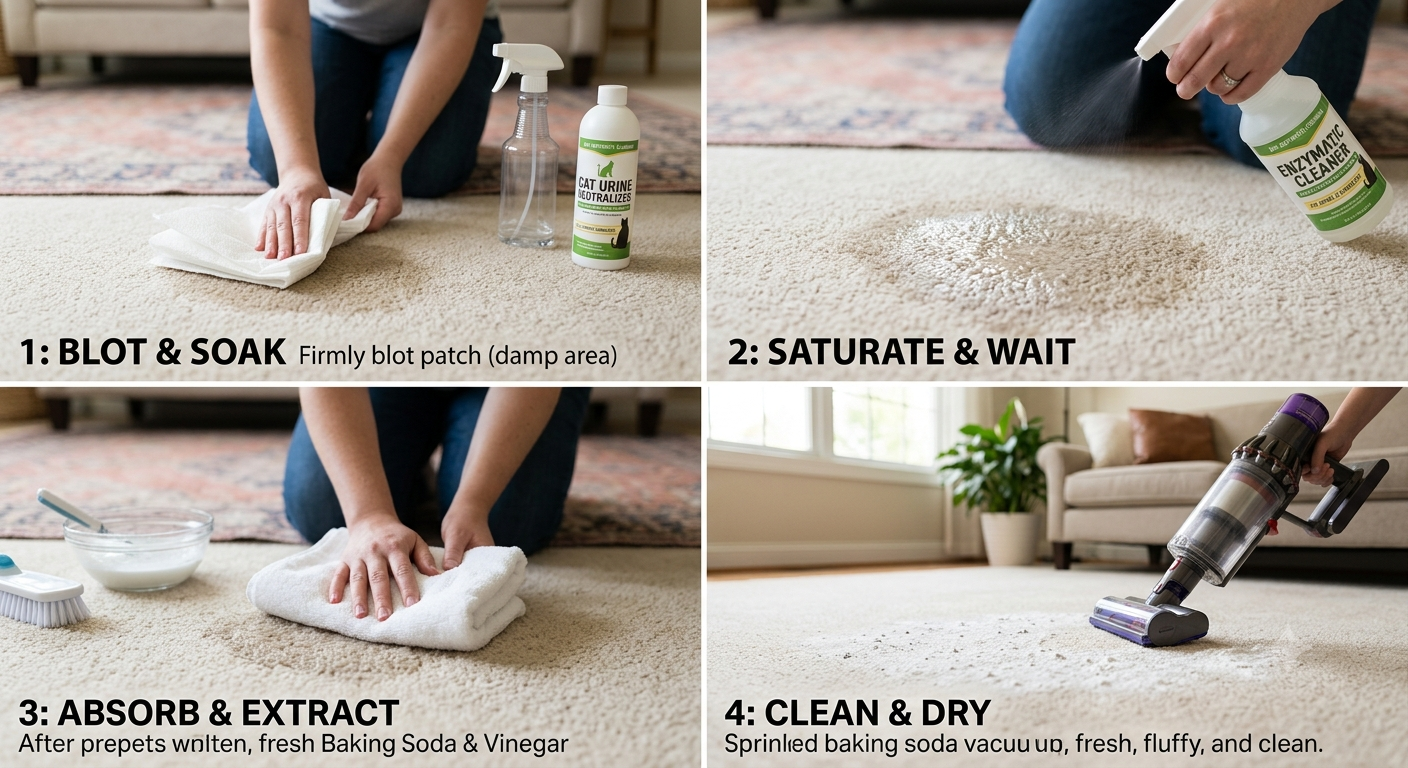
How to Clean Cat Pee Smell Out of Carpet Completely: Step-by-Step
This is the exact process I follow, in order. Skipping steps — especially the blotting step — is where most people go wrong.
- Blot immediately if the stain is fresh. Press paper towels straight down onto the spot, don’t rub. Rubbing pushes urine deeper into the padding, which makes everything harder later.
- Find the full extent of the stain with a UV flashlight if it’s already dry. Urine spreads wider under the surface than it looks on top, so mark the edges with painter’s tape.
- Saturate the area with enzymatic cleaner, not just spray the surface. You need enough liquid to reach the same depth the urine soaked into — usually means using more product than the label suggests.
- Let it sit, uncovered, for the time listed on the bottle — typically 10 to 15 minutes, sometimes longer for older stains. This is the part people rush, and it’s the whole reason enzyme cleaners work.
- Cover the spot with a damp towel and a flat object on top (a plate, a book) for several hours or overnight. This keeps the enzymes working while the moisture stays trapped against the padding.
- Blot dry, then let it air-dry completely before walking on it or vacuuming. Damp carpet trapped odor is one of the biggest reasons smells come back.
- Repeat once more if the stain was old or heavily soaked. Deep, set-in stains almost always need a second treatment.
Fresh Stains vs. Old, Set-In Stains
Fresh Stains (Same Day)
Fresh stains are honestly the easy version of this problem. Blot first, apply the enzyme cleaner generously, and you’ll usually only need one treatment. I keep a bottle under my kitchen sink specifically because timing matters this much.
Best Pet Food in Summer – A seasonal nutrition guide breaking down how to adjust your dog or cat’s diet for hot weather, emphasizing high-moisture cooling foods (like wet, fresh, and raw options) to prevent dehydration and digestive slowdowns.
Old or Dried Stains
Dried stains are a different beast. The crystals have had time to settle deep into the carpet backing and sometimes the subfloor underneath. For these, you’re looking at:
- A longer soak time with the enzyme cleaner (30+ minutes)
- Possibly re-wetting the spot with a little water first so the enzymes can actually reach the crystals
- Two or three rounds of treatment over a few days, not just one
I had a stain in a rental apartment that took four separate treatments spread across a week before the smell was genuinely gone. It’s frustrating, but rushing it just wastes product and time.
When the Smell Keeps Coming Back
If you’ve treated a spot and the odor returns, one of these is almost always the reason:
| Possible Cause | What’s Happening | Fix |
|---|---|---|
| Urine soaked into the padding or subfloor | The carpet surface is clean, but the source underneath isn’t | Pull back carpet edge, treat padding directly, or replace that section |
| Cleaner didn’t fully saturate the stain | Only the top layer got treated | Re-treat with more product, deeper application |
| Carpet dried too fast or wasn’t covered | Enzymes didn’t have time to break down crystals | Redo with the cover-and-wait method, minimum several hours |
| Cat is re-marking the same spot | Residual scent (even faint) is drawing them back | Use a UV light to confirm it’s fully gone, then consider a repellent spray on that spot |
Common Mistakes to Avoid
I’ve made a few of these myself, so learn from my trial and error.
- Using ammonia-based cleaners. Urine contains ammonia, so cleaning with an ammonia-based product can actually make cats more likely to re-mark that same spot.
- Steam cleaning before the stain is treated. Heat can permanently set the protein and odor into the fibers, making it nearly impossible to remove afterward.
- Rubbing instead of blotting. This pushes urine deeper and spreads the stain wider than it needs to be.
- Not using enough product. A light spritz on top of the stain barely touches the surface — you need to match the volume of the original accident.
- Skipping the “cover and wait” step. Letting the cleaner air-dry on its own cuts the treatment time way short and leaves crystals half-broken-down.
- Cleaning only the visible stain, not the full spread. Urine wicks outward under the surface, so the smell can persist just outside the area you actually treated.
How to Stop Your Cat From Re-Marking the Same Spot
Even after a stain is fully clean, cats sometimes keep going back to the same corner out of habit. I dealt with this in a hallway for almost two months before I figured out what actually broke the cycle.
A few things that helped in my house:
- Blocking the spot temporarily with a chair, mat, or even a piece of foil — cats generally dislike walking on foil, and it buys the treated area time to fully dry and off-gas.
- Placing a litter box near the spot for a week or two, then gradually moving it back to its usual location. This sounds counterintuitive, but it redirects the habit fast.
- Double-checking litter box basics — is it clean enough, is there another cat guarding it, is it in a noisy or high-traffic spot? A surprising number of “random” accidents trace back to litter box stress rather than the carpet itself.
- Using a citrus-scented spray on the cleaned area once it’s dry. Most cats dislike citrus, and it’s a gentler deterrent than anything harsh-smelling.
If the same spot keeps getting targeted even after all of this, it’s worth treating it as a behavior or litter box issue rather than just a cleaning one.
When It’s More Than Just a Carpet Problem
If your cat has suddenly started peeing outside the litter box — especially if it’s frequent, on multiple surfaces, or paired with straining, crying, or blood in the urine — it’s worth calling your vet sooner rather than later. Repeated inappropriate urination can sometimes point to a urinary tract infection, bladder stones, or stress-related issues, and a vet can rule out anything medical before you assume it’s purely a behavior problem.
This isn’t meant as a diagnosis, just a heads-up: if the pattern feels sudden or out of character for your cat, a vet visit is the safer first step before trying to solve it purely with training or carpet cleaning.


One Comment